Supported by
retiring
Getting Benefits of Retirement Home Care, at Your Own Home
Continuing care retirement communities are widening their scope to help retirees age in place, with measured supports and a way to cap the soaring costs of aging.

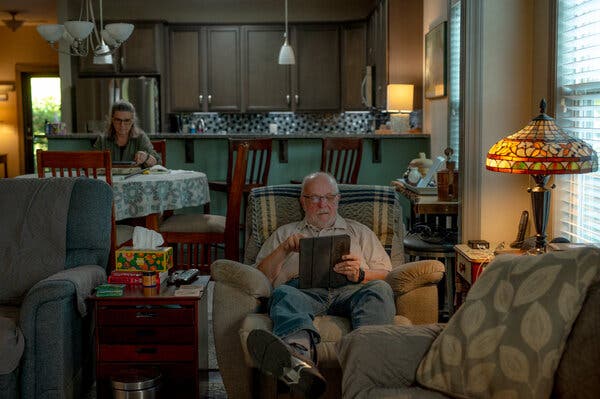
Not a single step interrupts the path, lined with thyme, to the front door of Joan Brasier’s ranch house in Asheville, N.C. With its remodeled primary bath and easy-to-clean surfaces, Ms. Brasier intends to stay in her home with her husband, Paul Wilczynski, for the foreseeable future.
It’s the unforeseeable, though, that has worried them. She and Mr. Wilczynski, both retired, want to travel. But they were concerned about spending money for fun today that they may need for care tomorrow, even though their careful calculations showed they could most likely afford it.
The couple found a solution in a little-known retirement model of care that is gaining momentum. “Continuing care at home,” provided through a continuing care retirement community, blends the expertise of those communities with support for members staying in their own homes. Members of these programs can move into the facility they contract with, if they need to, with the assurance of containing future costs.
About 75 percent of American adults in a 2024 AARP survey said they hoped to stay in their longtime homes, or “age in place,” as long as possible, with only 29 percent of older adults in the survey saying the traditional continuing care model was a likely choice. That model not only involves moving but requires a hefty entry fee and monthly fees to live on-site, where residents can transition to higher levels of care as their needs dictate. The at-home model has been operated by a few communities for decades, creating enough of a track record for the long-term-care industry to adopt it more widely.
Advertisement
This option is offered by only 37 of the country’s 1,911 continuing care retirement communities, or C.C.R.C.s, according to an industry group, LeadingAge, up from 26 a decade ago. More are exploring the concept, as evidenced by the escalating participation in the group’s conference on the topic.
Ms. Brasier, 74, and Mr. Wilczynski, 78, enrolled in Givens Choice, a three-year-old operation of Givens Communities in western North Carolina. The program provides regular health check-ins and coaching with a geriatric care specialist, known as the care manager, with the assurance of long-term care in a facility, at a fixed price.
“If we need a little bit of help, we get a little bit of help,” Ms. Brasier said. “If we need to go into care, we go into care.”
Depending on a person’s health and projected needs, Givens Choice’s plans start with a one-time fee that typically ranges from $33,000 to $77,000, for members entering at age 65 in good health, plus monthly care-management fees starting around $570. The program fees are for individuals, though couples receive a slight discount, said Erin Strain, executive director of the program.
Like all such programs, the Givens Choice program holds the entry fee to apply to future care expenses, while the monthly fee covers the check-ins and professional guidance — say, arranging in-home help like an aide or housekeeping — that enable members to stay in their homes as long as possible.
Advertisement
The Givens Choice at home plan does cover some aspects of support for members who need help at home beyond what Medicare will cover. That support is at the recommendation of the care manager and is limited according to each member’s contract. If at-home members need to move into the C.C.R.C. facility, they pay only the monthly fee (adjusted for inflation) that they had been paying all along.
For Ms. Brasier, the program swung into action a few months ago when she injured a shoulder in a fall while walking her dog. The couple’s Givens Choice care manager, already familiar with the household, stepped in to arrange at-home services that buoyed Ms. Brasier through the worst of her recovery. The monthly fee covered the manager’s work, and even some meal delivery. Medicare covered her health care.

A continuing commitment
Affordable late-in-life care is the holy grail for millions of American families. The latest data from Pew Research found that while most people hoped to age at home, they weren’t sure if they could. Of those who hoped to age in place with caregiver help, according to Pew research released in February, 37 percent said they thought they could pull it off.
Traditional continuing care retirement communities address many of these issues, but at a high price. Nationwide, the typical entry fee for on-site living ranges from $400,000 to $700,000, according to LeadingAge, although it can be lower or higher. It’s not uncommon for people to use proceeds from selling their home to pay that fee, yet the median home equity for homeowners 65 and older is $250,000, leaving a big gap. The cost is daunting for many families, especially if they hope to preserve their home equity for their heirs.
Advertisement
The at-home care model costs much less than the traditional option because members continue to pay any mortgage, insurance, taxes and maintenance on their properties. While members can gain access to some on-site community amenities, such as cultural programs and fitness facilities, they remain responsible for their own meals and daily costs of living. For on-site residents, monthly fees typically include meals, property maintenance, most utilities and other basic living expenses.
For admission, at-home members must pass a battery of physical and cognitive tests that are more stringent than for on-site residents. (Cognitive decline is the most common reason for being disqualified by Givens, Ms. Strain said.) Thus, at-home members usually join in their mid-70s, about eight years younger than the average on-site C.C.R.C. resident. An organization expects to collect monthly care fees for years before people become infirm, and also invests entry fees, according to executives at several C.C.R.C.s.
Timing your application for care at home is everything, said Paul Stavros, vice president of the Vibrant Life at Home division of Sun Health in Arizona. Begun in 2016, it has over 220 members in the western Phoenix area. He and other industry executives said that enrolling early and in good health increased the chances of being accepted and reduced the initial cost.
Each continuing care organization sets its own pricing structure for at-home programs, but across the country, the entry fees typically range from about $50,000 to hundreds of thousands per person, with members signing contracts outlining their fee structure and projected future costs.
All fees are tied to the prospective member’s age and health status and the type of contract that he or she buys. Some contracts are all inclusive, while others have co-pays for the cost of care, some up to 50 percent.
Advertisement
If a member later wants to cancel, any refund is dictated by the contract. At least three states — New York, North Carolina and New Hampshire — have specific regulations regarding at-home care plan cancellations, according to LeadingAge.
The business perspective
Fundamentally, the at-home programs act as a form of long-term-care insurance, integrated with monthly care and wellness management.
The numbers work for both the organizations and the individuals because it’s basic insurance-style math, said Brad Paulis, a partner with Continuing Care Actuaries. (Typically, C.C.R.C.s are regulated by state insurance departments, though they technically are not insurers.)
The at-home programs, Mr. Paulis said, pull money from a pool of healthy people and help keep members healthier longer, achieving individual longevity goals while minimizing risk for the organization.
Advertisement
Thirty percent of older Americans die before they need any late-in-life institutional care, Mr. Paulis said. “Another 40 percent use minimal care — under 90 days, before end of life. That’s why long-term-care policies have deductible periods,” he said, referring to the period that consumers must wait for payouts. The final 30 percent of Americans will have substantial long-term care bills, he said.
What to do before applying
Despite the complexity of the C.C.R.C. options, the at-home model appears to fill a caregiving gap — if families can learn about it in time for elder relatives to qualify. Here is what potential members need to do before applying.
Scout and compare at-home programs, as organizations are figuring out how to market them and information about pilots may be difficult to find.
Cut through confusing language: Many C.C.R.C.s call people on their regular waiting lists “at home” residents, said Margaret Johnson, a senior director with Fitch Ratings, which assesses the financial status of C.C.R.C.s. Ask for clarity.
Calculate the cost of staying at home, like making modifications to your house and choosing and managing at-home services. “Only 14 percent of middle-income older adults can afford four or more hours a day of in-home health care,” said Lisa McCracken, head of research and analytics for the National Investment Center for Seniors Housing and Care. “That tells us that for them, aging in place is not always a great plan, either.”
Couples must assess how they’ll manage and pay for care if their needs and health diverge. One spouse may have a progressive disease while the other’s health is more stable. Often, programs offer support and care coordination to both spouses, even if the contract covers only the healthier spouse, said Dee Pekruhn, senior director of life plan communities and continuing care at home with LeadingAge.
Consider your friendships and other social connections, which you could cultivate by living in a facility rather than at home. At-home care may exacerbate isolation, which can put older people’s health at greater risk.
Lesley Morter said she wished she had known about such programs several years ago, when her mother, now 88, was still living in her own home. As Ms. Morter was exploring options, the family’s plans crumbled.
Now, Ms. Morter, 60, is trying to patch together a strategy to ensure that her mother’s care plan at least keeps pace with her income — a seemingly impossible task.
With her mother’s house sold and her capabilities erratic, Ms. Morter and her family are finding that the puzzle pieces don’t fit. “We’re scrambling,” she said.
An earlier version of this article misstated the coverage provided under the Givens Choice at-home care plan’s monthly fee. The monthly fee will cover some limited at-home support for members that isn’t covered by Medicare.
We acknowledge mistakes in our reporting with corrections. If you spot an error, please let us know at corrections@nytimes.com.Learn more.
Related Content
Advertisement